
An industrial MIG welding machine should be sized to the thickest steel you weld every week, not the thickest you might ever touch. Budget roughly 1 amp of output for every 0.001 inch of mild steel thickness in a single pass, then insist on a duty cycle rating at that exact amperage rather than at the headline maximum. A machine advertised as 250 A is only a 250 A machine if it can hold the arc for six minutes out of ten at 250 A. Everything else in the quotation - input phase, shielding strategy, consumables, spares availability and third-party certification - either protects that output or quietly erodes it.
If you remember nothing else: buy for duty cycle and serviceability, not for peak amperage. Peak amps sells machines; duty cycle finishes jobs.
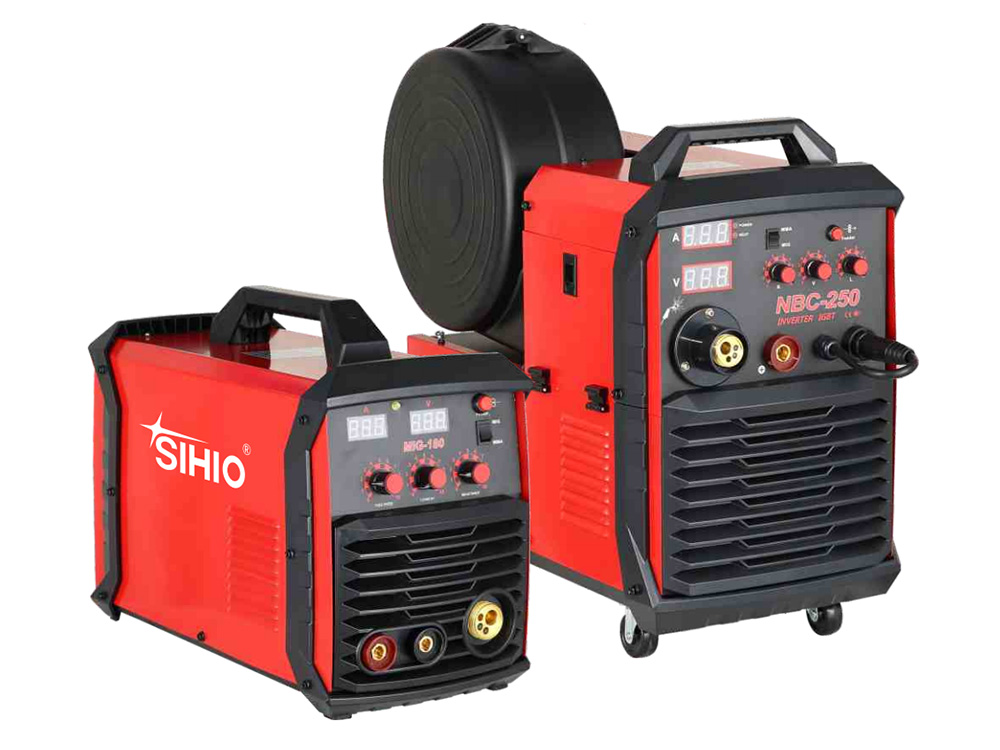
Spend an hour on any welders forum and the same complaints repeat. Fabricators buy a machine rated 200 A, discover it trips its thermal protection after ninety seconds of continuous seam, and conclude the rating was fiction. In most cases the number on the box was technically true and practically useless, because it was measured under conditions the buyer would never reproduce.
There are four recurring sources of that gap.
Manufacturers publish duty cycle at a chosen test amperage. A 40 percent duty cycle at 90 A sounds respectable until you realise the work you bought the machine for runs at 180 A, where the same unit may only manage 15 to 20 percent. The fix is simple and worth putting in writing in every request for quotation: ask for the duty cycle at your working amperage, and ask for it at 40 degrees Celsius ambient, which is the standard reference temperature in IEC 60974-1 rather than a comfortable 20 degrees Celsius bench.
A 230 V single-phase machine drawing useful output still has to live inside the limits of the circuit feeding it. Standard household circuits are 15 or 20 A, which caps continuous input power at roughly 1.8 to 2.4 kW. Upstream of that wall socket there is no amount of clever inverter topology that manufactures extra power. Shops that skip the electrical survey end up with a machine that either trips breakers or silently derates.
Experienced buyers repeat a version of the same arithmetic: a 130 dollar welder becomes a 250 to 300 dollar set-up once you add ground clamp, regulator, wire, contact tips and a helmet that actually darkens. Scale that same logic to industrial equipment and the accessories, gas infrastructure and consumable stream can equal or exceed the machine cost within the first year of operation.
The most expensive machine in the world is one that stops for six weeks waiting for an IGBT module or a wire feeder control board that nobody stocks locally. Before signing, ask which wearing parts are held in your country, what the lead time is, and whether schematics are available to your own maintenance team.
Start with steel, not with machines. List the three most common joints your shop produces and note the thickest member. That single number drives the sizing decision more than any feature list.
The classic field rule for mild steel is approximately one amp of output per 0.001 inch of thickness per single pass. Translating that into shop language gives a useful sizing ladder:
| Output current | Typical single-pass capacity (mild steel) | Realistic application |
|---|---|---|
| 120 to 140 A | Up to about 1/4 inch | Sheet metal, brackets, light repair, body panels |
| 180 A | 5/16 to 3/8 inch | General fabrication, gates, railings, light structural work |
| 200 A | 3/8 to 7/16 inch | Structural repair, chassis work, most job-shop output |
| 250 A | Around 1/2 inch | Medium plate, trailer manufacture, agricultural equipment |
| 350 A and above | 1/2 inch and thicker, multi-pass heavy plate | Shipbuilding sections, pressure vessels, continuous production |
Two adjustments matter. Stainless steel needs roughly 10 to 15 percent less heat input than mild steel at the same thickness, because it conducts heat less readily and is more prone to distortion. Aluminium needs roughly 25 percent more, because its thermal conductivity pulls heat out of the joint faster than a steel joint would.
A practical sourcing habit: multiply the thickest plate you weld monthly by 1.25 and size the machine for that. This buys headroom for dirty material, poor fit-up, cold shops and the day someone brings you a job you would normally refuse. Buying the next size up costs far less than replacing an undersized machine twelve months later - a mistake buyers describe again and again as outgrowing the welder.
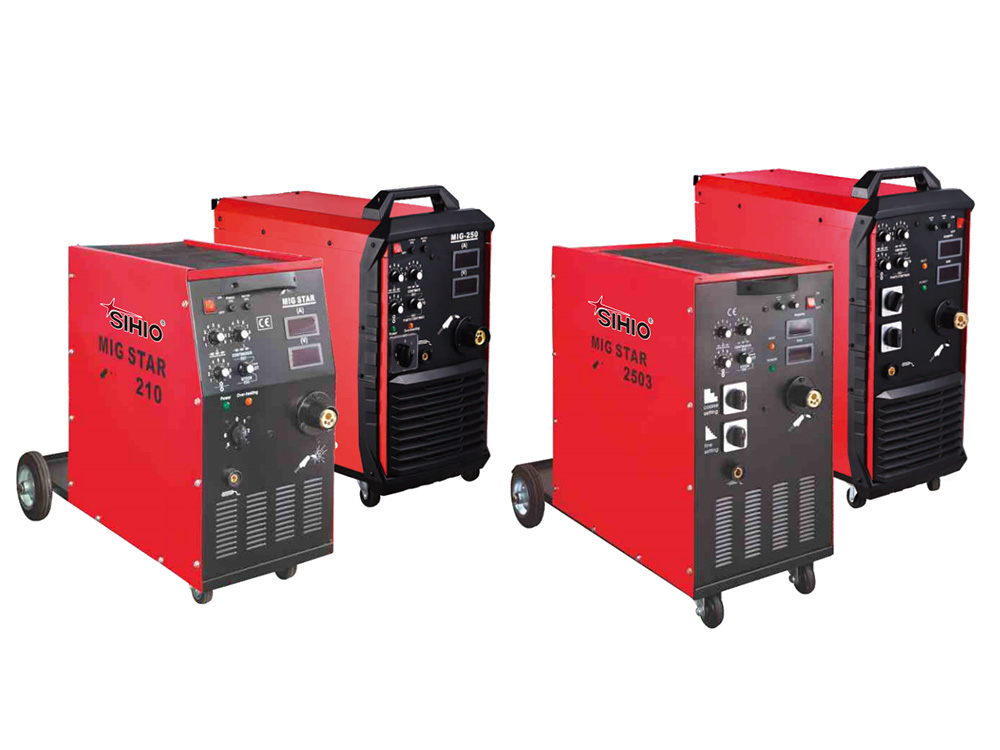
Duty cycle is a percentage of a ten-minute window. Machine rated 60 percent at 200 A welds continuously for six minutes at 200 A and must then rest for four. Reduce the amperage and duty cycle rises; push toward the maximum and it collapses. That relationship is why a low-amperage machine can effectively have double or triple the real duty cycle at 60 to 70 percent of its maximum.
| Machine class | Typical duty cycle at maximum output | Typical duty cycle at reduced output | Fits what kind of work |
|---|---|---|---|
| Entry / hobby inverter | 20% at maximum | 35 to 40% mid range | Short tacks, learning, occasional repair |
| Prosumer / light industrial | 30 to 40% at maximum | 60% mid range | Regular fabrication, long seams with pauses |
| Industrial duty | 60% at maximum | 100% at reduced output | Continuous production, paid contract work |
| Stick / MMA reference | Often below 25% at maximum | Higher at reduced output | Field repair, outdoor work, structural |
To translate percentages into something your production planner can use, apply this formula:
Available arc minutes per hour = 60 x duty cycle (as a decimal). A 30 percent duty cycle delivers 18 arc minutes per hour; a 60 percent unit delivers 36. If your shop runs two operators per machine across an eight hour shift, that difference is the difference between shipping today and shipping tomorrow.
Put three things into the purchase contract. First, the duty cycle at your working amperage at 40 degrees Celsius ambient per IEC 60974-1. Second, a factory acceptance test that runs the machine at working output until thermal equilibrium, logging case temperature at the rectifier and transformer. Third, a penalty clause covering sustained output shortfall. Suppliers who actually build machines agree to these terms routinely; trading companies rarely will.
Finally, check thermal protection behaviour rather than just its presence. Well designed industrial units ramp down gradually and display an error code. Poor ones cut out abruptly mid-bead, which ruins the workpiece and teaches operators to distrust the equipment.
This decision is dictated by your premises, then confirmed by your amperage requirement. Single-phase 230 V is what most small workshops and all domestic supplies provide. It is convenient and portable, but in practice it tops out around 250 A for MIG and MMA when you combine it with any meaningful duty cycle. Above that, expect compromise at the top end of the dial.
Three-phase 400 V unlocks higher sustained amperage, better duty cycle at that amperage, cooler operation and greater electrical efficiency under heavy load. If the supply is available, a three-phase industrial machine is almost always the better long-term choice for serious fabrication. This is also why many manufacturers offer the same chassis with either input board - and why searching for an industrial MIG welding machine with three-phase input is a fundamentally different exercise from shopping for a portable 230 V unit.
| Consideration | Single-phase 230 V | Three-phase 400 V |
|---|---|---|
| Typical ceiling | Up to roughly 250 A usable | 350 A and above common |
| Duty cycle at top output | Compromised | High and stable |
| Installation cost | Usually none - existing socket | Electrician, cabling, possibly supply upgrade |
| Efficiency under heavy load | Moderate | Better, less heat, lower running cost per kilogram of weld metal |
| Best application | Site work, maintenance, small shops | Production lines, heavy fabrication, continuous duty |
One caveat that catches people out: check input amperage, not output amperage. Some machines described as single-phase still demand 32 A or more at the plug. Others include dual-voltage capability, feeding 110 V (120 V) for light work and 220 V to 240 V for heavy work from the same unit. Dual-voltage hardware costs a little more and is often the cheapest insurance against the most expensive purchasing mistake in welding - buying a machine you outgrow in a year.
The choice between solid wire with shielding gas and self-shielded flux-cored wire is a choice about three variables: appearance, portability and operating cost. Neither is universally correct.
| Factor | Gas-shielded MIG (C25, 75% argon / 25% CO2) | Gasless flux-cored |
|---|---|---|
| Bead appearance | Clean, minimal spatter, little post-weld grinding | Rougher, visible spatter, more clean-up |
| Outdoor / windy work | Poor - wind blows shielding gas away | Excellent - self-shielding |
| Dirty or rusty material | Less tolerant | More tolerant, better penetration on contaminated steel |
| Upfront equipment | Cylinder, regulator, hose (roughly 150 to 200 USD starter) | None beyond the wire |
| Consumable cost | Lower per metre of weld | Flux-cored wire costs more per kilogram |
| Fume generation | Lower | Higher - plan ventilation and respiratory protection |
| Learning curve | Beginner friendly, more forgiving settings | Forgiving on technique, less so on settings |
For a shop working indoors on clean material where welds are visible, gas MIG wins on both quality and economics. For site erection, agricultural repair, galvanised repair work or any job where the wind is part of the environment, flux-cored is not a compromise - it is the correct specification.
The pragmatic industrial answer for most buyers is a machine that does both. Multi-process units cost slightly more than single-process equivalents and remove an entire category of future regret, because the operator can switch wire and polarity rather than buy a second machine.
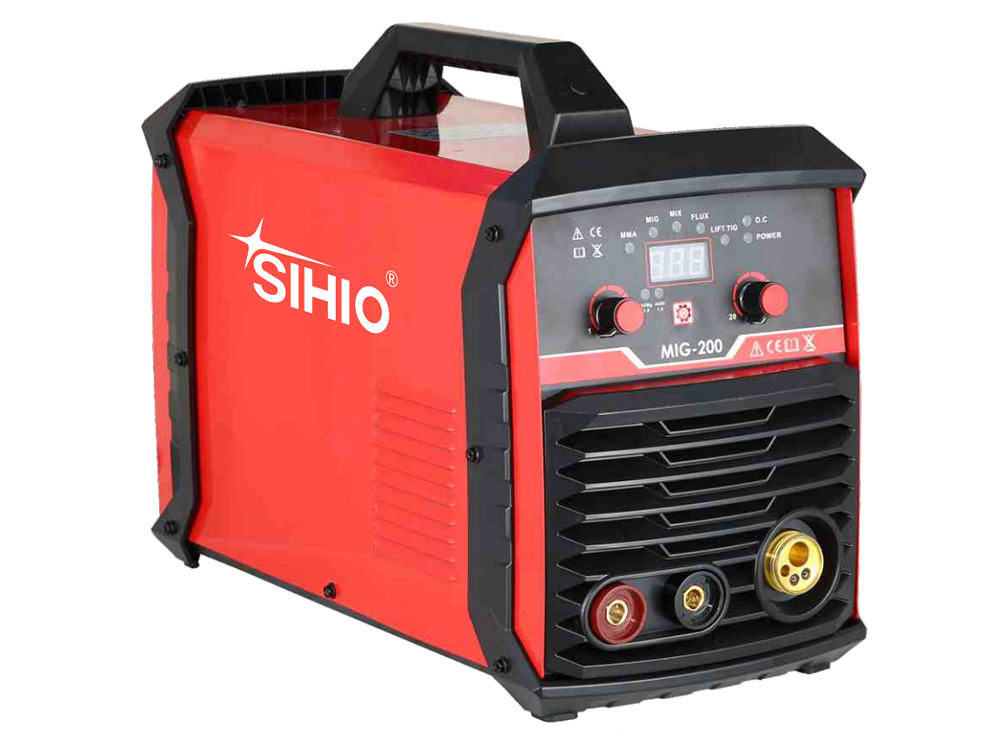
Two machines with identical rating plates can produce noticeably different beads, and the difference usually lives in the wire feed system and the arc control parameters rather than in raw power. These are the details that decide how often an operator stops to grind spatter.
Wire diameter determines current density, which in turn determines penetration profile and deposition rate. Getting it wrong is one of the most common reasons a correctly sized machine still produces poor results.
| Wire diameter | Typical current window | Typical material thickness | Where it is used |
|---|---|---|---|
| 0.6 mm / 0.023 in | 30 to 90 A | 0.6 to 1.6 mm | Thin sheet, automotive panel, visible welds with minimal burn-through |
| 0.8 mm / 0.030 in | 60 to 180 A | 1.0 to 4.0 mm | The default industrial general-purpose size |
| 0.9 to 1.0 mm / 0.035 in | 120 to 250 A | 3.0 to 8.0 mm | Structural fabrication, higher deposition, fillet welds |
| 1.2 mm / 0.045 in | 180 to 350 A | 6 mm and above | Heavy plate, high deposition, typically on 350 A class machines |
| 1.6 mm / 0.062 in | 250 A and above | Heavy section and overlay work | Submerged arc territory in most shops rather than standard MIG |
A useful rule of thumb: for a given wire diameter there is a current below which the arc becomes unstable and above which the wire stubs or burns back violently. If your work spans both thin sheet and plate, plan either for two wire sizes with quick-change drive rolls, or for a machine with enough parameter memory to store both setups.
Standard gas-shielded MIG and most flux-cored wires run on direct current electrode positive, which places roughly two thirds of the heat in the workpiece and delivers the deeper penetration profile most fabricators expect. Direct current electrode negative puts more heat into the wire and produces a flatter, wider bead with higher deposition and less penetration - useful for sheet metal and for some hardfacing applications. Reversing polarity is also the switch between solid wire and self-shielded flux-cored wire on many machines, so if you intend to run both, check that polarity reversal is a physical link change the operator can perform in under a minute rather than a service job.
Wire feeding problems masquerade as arc problems more often than most operators realise. A four-roll drive system feeds significantly more consistently than a two-roll unit, especially over longer guns and with softer wires such as aluminium. Liners should be matched to wire type - a steel liner used for aluminium will score the wire and cause bird-nesting at the drive. Gun length matters too: beyond about four metres, a push gun begins to struggle and a spool gun or push-pull setup becomes the correct answer.
Ask your supplier which drive roll groove types ship with the machine, whether a spare set of rolls for aluminium is included, and how quickly the liner can be changed without tools. These questions rarely appear in brochures and they determine how much of the first month is spent welding rather than clearing feed faults.
Synergic control couples wire feed speed to voltage so that changing one parameter automatically adjusts the other along a tuned curve. For low-volume operators and mixed-experience teams this removes the single most common defect source - mismatched parameters - and it is worth specifying for that reason alone. More experienced welders generally prefer manual mode, because fine-tuning voltage independently alters arc length and bead profile in ways a fixed curve cannot.
Look specifically for machines that offer both, and check whether the synergic curves are tuned for the wire diameters you actually use. Inductance adjustment is worth having for anyone welding stainless or running short-circuit transfer on thin material: raising inductance softens the arc and reduces spatter at the cost of a wetter puddle, while lowering it produces a stiffer, more focused arc. Trigger modes also matter more than they appear to. Crater fill and burn-back control protect the contact tip and prevent the wire sticking in the puddle at the end of a run, which over thousands of welds translates directly into consumable savings.
Finally, verify low-amperage behaviour. A machine that arcs beautifully at 200 A and sputters at 45 A is a poor general-purpose choice regardless of its headline specification, because thin sheet work punishes weak low-end stability. Test at the bottom of the range on your thinnest material before signing.
Total cost of ownership is where two quotations with identical machine prices diverge by forty percent over three years. Build the comparison yourself rather than accepting a supplier spreadsheet.
| Cost element | Typical range (USD) | Notes for industrial buyers |
|---|---|---|
| Shielding gas cylinder and first fill | 150 to 200 | Rental versus purchase changes ongoing cost significantly |
| Regulator and flowmeter | 40 to 80 | Buy once per machine, not once per year |
| Solid wire ER70S-6, 0.030 inch | Around 25 per 10 lb spool | Ask about bulk pricing above 500 kg per year |
| Contact tips, nozzles, liners | 10 to 30 per set | Highest-volume true consumable - negotiate stock levels |
| Auto-darkening helmet | 80 to 250 | Cheap helmets slow operators down and cause rework |
| Ground clamp and leads upgrade | 25 to 50 | Pure copper lasts longer than copper-clad aluminium under load |
| Electrical installation (three-phase) | Varies widely | Often exceeds the price difference between machine classes |
| Preventive maintenance and spares | 2 to 5 percent of machine price per year | Model this explicitly; discount vendors who omit it |
Three hidden costs deserve separate attention.
A stopped production welder costs the operator wage, the schedule penalty and often the rush freight to recover. A machine that is 15 percent cheaper and fails twice as often is not cheaper. Ask for mean time between failure data if the supplier has it, and ask what happens when it fails.
Inverter machines are dramatically more efficient than transformer units of the same output, which is why modern inverter platforms dominate both budget and industrial segments. Comparing inverters against old transformer stock is not a fair fight, but it is a real purchasing situation in many markets - and a modern inverter usually pays for its own efficiency premium within a few years of regular use.
Poor arc stability at low amperage, unstable wire feed and badly tuned synergic curves produce spatter, lack of fusion and rework. Those costs never appear on a quotation. Test weld on your own material, with your own wire, before committing to a fleet order.
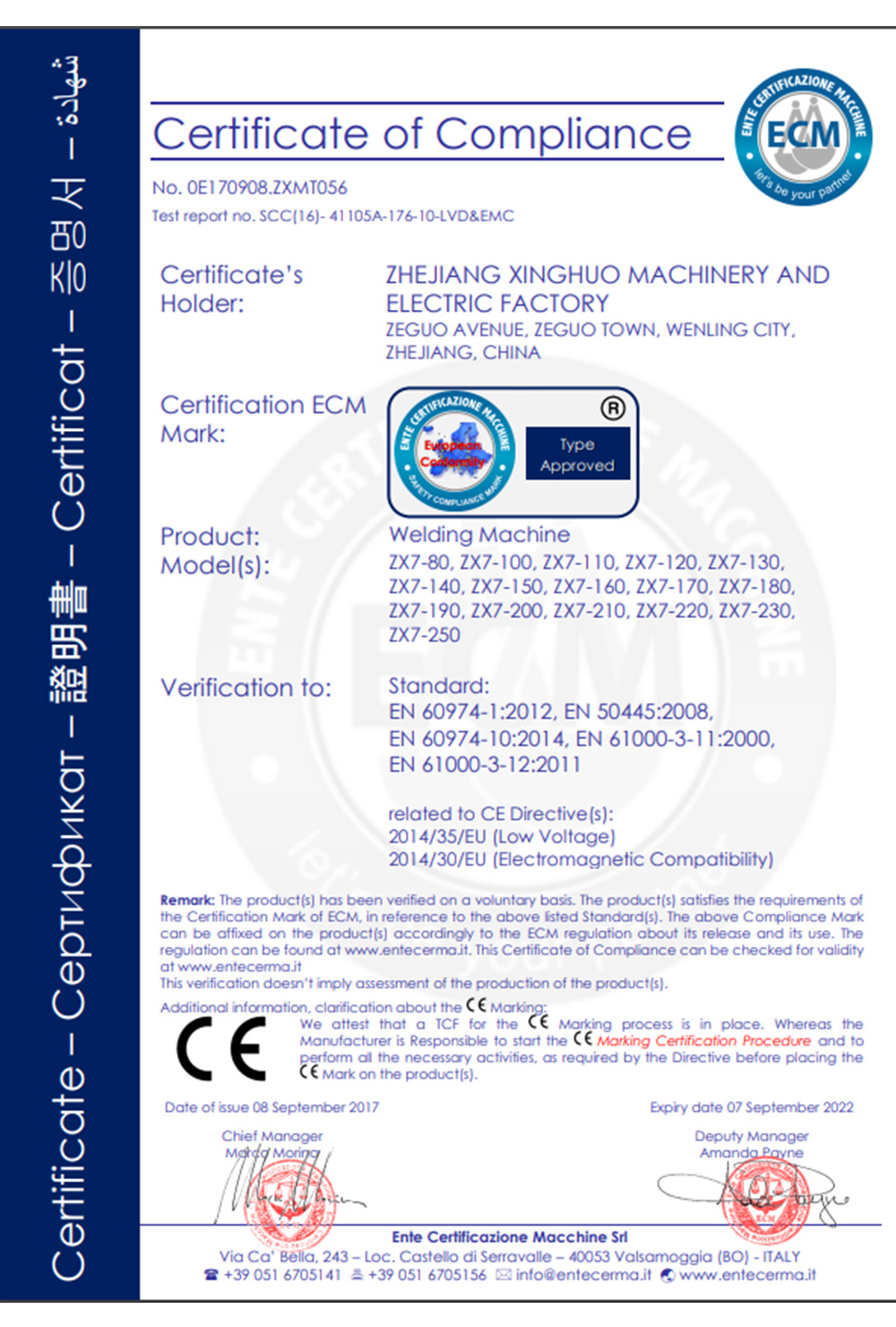
Certification is not decoration - it is the only part of a specification you can verify independently. Any credible manufacturer can send the following within a day; reluctance is itself a finding.
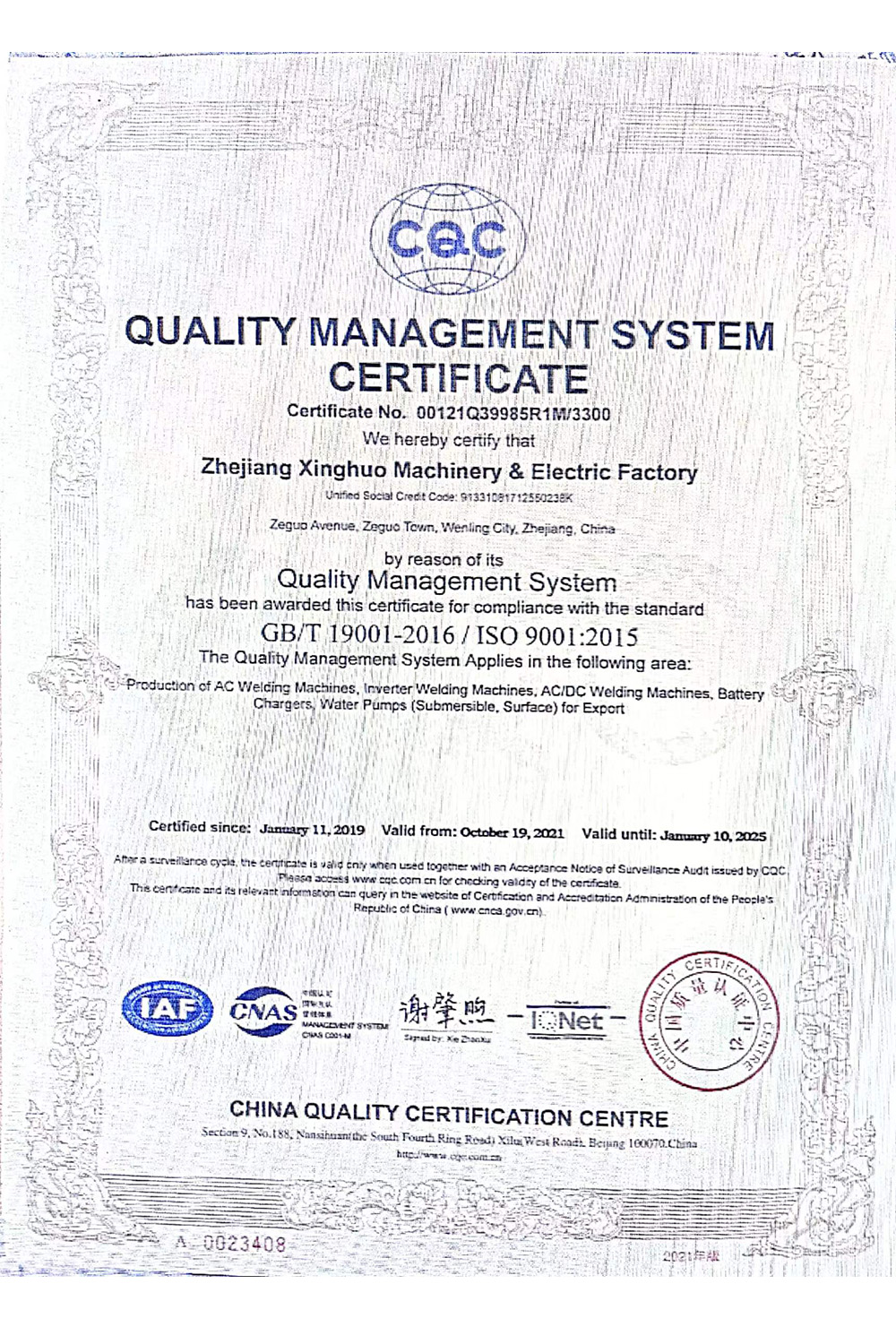
ISO 9001 quality management certification, current, with scope covering welding equipment manufacture and an issuing body you can look up.
CE declaration of conformity referencing the applicable harmonised standards, not a logo pasted on a nameplate.
IEC 60974-1 type test report covering the exact model you are buying, showing duty cycle, ambient reference temperature and no-load voltage.
EMC test report for your market, since inverter welding power sources are significant electromagnetic emitters.
RoHS declaration where required by your import rules, plus REACH documentation for European buyers.
Country-specific approvals - GS, TUV, UL, CSA or local equivalents depending on destination.
Serial traceability linking finished units back to component batches, which matters enormously when a rectifier failure affects a production lot.
Ask for certificates in the name of the legal entity that owns the factory. Certificates issued to a trading company in a different name tell you nothing about who actually wound the transformer.
Send this to every supplier you are considering. Differences in how suppliers answer are more revealing than the numbers themselves.
| Parameter | What to write in your enquiry |
|---|---|
| Rated output | Required amps at duty cycle: ____ A at ____ % duty cycle, measured at 40 degrees Celsius ambient |
| Output range | Minimum usable ____ A to maximum ____ A, with stability at the low end specified |
| Input supply | ____ phase, ____ V, ____ Hz, with declared input current at full output |
| Processes required | MIG / MAG, flux-cored, MMA, TIG lift or HF start, plasma cutting - list each one |
| Wire capability | Spool size ____ kg, wire diameters ____ mm, driven roll types included |
| Duty cycle verification | Factory test report required at ____ A; acceptance criteria defined before shipment |
| Cooling | Forced air / fan-on-demand / water-cooled torch circuit |
| Protection class | IP rating required for your environment: ____ |
| Safety features | Thermal overload with error code, VRD where required, over-voltage and under-voltage behaviour |
| Certification | ISO 9001, CE to IEC 60974-1, EMC report, RoHS, plus any country-specific approval |
| Documentation | Full English service manual, exploded parts diagram, circuit schematics, firmware version record |
| Spares commitment | Critical spares stocked in ____ for ____ years; lead time stated in days |
| Warranty | ____ months parts and labour, with the claims procedure written into the contract |
| Sample policy | One production sample shipped before bulk order, tested at our facility |
Whether you visit in person or run a video audit, these questions separate a manufacturer from an office with a catalogue.
Can we see the IGBT module inventory and the incoming inspection records for the last batch?
How many welding machines of this exact model range were produced last month, and can we see the line?
Who winds or sources the main transformer and reactors - in-house or contracted, and to what specification?
What burn-in or load testing does every unit receive before packing, and for how long?
What is the failure return rate for this model in the last twelve months, by failure category?
Can we see the duty cycle test rig and a live reading during a sustained run?
Which components are dual-sourced, and what happens if the primary supplier fails?
How is firmware version controlled, and can we receive release notes for our serial range?
Is there an engineering team capable of modifying the product for our voltage, plug or labelling requirements?
Can we interview the QC manager rather than a salesperson?
What tooling and jigs would be required for an OEM variant, and who pays for them?
Can you provide three distributors in our region who have bought this model for at least two years?
A manufacturer answers these with specifics, usually with mild pride, and often invites you to watch the test rig running. Intermediaries ask why you need to know.

Write acceptance criteria before shipment, not after delivery. A straightforward protocol works well: run the specified duty cycle test for one hour at working amperage using your own wire and gas mixture, log bead continuity and any thermal cut-outs, then inspect the first fifty metres of weld for porosity and lack of fusion. Record everything and attach it to the purchase order as grounds for acceptance or rejection.
Train operators on the specific unit, not on welding in the abstract. Modern multi-process machines have parameter menus that are powerful and easy to set wrong; an hour of structured familiarisation prevents months of poor beads blamed on the machine.
Finally, agree a spares plan. Consumable parts - contact tips, nozzles, liners, drive rolls - should be held on your own shelf. Critical semiconductors should be held either by you or by a local partner with a stated lead time. Whichever way you structure it, write it into the contract, because memory and goodwill are not supply chain strategies.
Around 250 A for a clean single pass in mild steel, using the rule of roughly 1 amp per 0.001 inch of thickness. A 180 A machine can weld 1/4 inch with multiple passes and good joint preparation, but it will sit near the top of its duty cycle doing so. If 1/4 inch is routine rather than occasional, specify 250 A with at least 40 percent duty cycle at that output.
It means the machine can weld continuously for six minutes out of every ten at the stated amperage before it must cool for the remaining four. Always check the amperage attached to the percentage - 60 percent at 90 A and 60 percent at 200 A describe very different machines. Ask for the rating at 40 degrees Celsius ambient to IEC 60974-1.
Three-phase 400 V is better whenever the supply exists, because it delivers higher sustained output, better duty cycle and cooler running. Single-phase 230 V is genuinely adequate up to roughly 250 A and remains the right choice for site work, maintenance and small shops where three-phase is unavailable or too expensive to install.
Indoors on clean steel where appearance matters, use gas-shielded MIG with C25 gas. Outdoors, in wind, or on galvanised and rusty material, use flux-cored because the shielding is generated by the wire itself. Many industrial shops standardise on machines that support both and switch wire and polarity per job rather than owning two fleets.
Because brochure figures are typically measured at a lower amperage and cooler ambient than your shop. Marketing also tends to quote the most flattering combination. The remedy is contractual: require duty cycle stated at your working amperage and 40 degrees Celsius, plus a factory test report to back it up.
Yes, and they dominate modern industrial ranges because they are lighter, more efficient and offer far better arc control than transformer machines. The caveat is that inverter reliability depends on component quality and thermal design, so buy from manufacturers who publish test data and stock replacement modules rather than from vendors whose only differentiator is price.
Shielding gas supply and refills, regulator and hose, contact tips and nozzles, liners, drive rolls, wire stock, a genuine auto-darkening helmet, improved ground clamp and leads, electrical installation for three-phase supply, and an annual maintenance and spares allowance of roughly 2 to 5 percent of machine price. A low sticker price frequently becomes a mid-range total cost once these are added.
At minimum ISO 9001 with manufacturing scope, a CE declaration referencing IEC 60974-1, an EMC test report for your market, and RoHS documentation. Depending on destination, add GS, TUV, UL, CSA or local equivalents. Verify certificates with the issuing registrar and confirm they are issued to the factory entity, not only to a trading company.
Yes. Multi-process inverter units are common and cost-effective if your work genuinely spans processes. Buy for the process you use most and confirm the others perform acceptably, because some multi-process units compromise TIG start quality or low-amperage MMA stability in order to hit a headline MIG specification.
Realistically up to about 1/4 inch in mild steel with good preparation, and comfortably at 1/8 to 3/16 inch. Claims beyond that usually assume multiple passes, preheating or ideal conditions. If your regular work includes 1/4 inch plate, buying the 180 to 200 A class costs little more and removes a persistent constraint.
Ask for the duty cycle test rig on video, request component batch traceability for a recent serial number, ask who winds the transformer, and request the monthly production quantity for the exact model. Real manufacturers answer these immediately and usually offer to show more. Intermediaries redirect the conversation back to the catalogue.
Twelve to twenty-four months parts and labour is standard for industrial machines, sometimes longer for transformer-based models. More important than duration is the claims procedure: who pays freight, how quickly replacement boards ship, and whether repairs can be handled locally. Get this written into the purchase contract rather than referenced in an email.
Specifying an industrial MIG welding machine is not a matter of finding the biggest number on the dial. It is a matter of matching four things honestly: the thickest steel you weld routinely, the duty cycle you can hold at that working amperage, the electrical supply you actually have, and the total system cost you will carry for the next five years. Get those four right and most remaining decisions - gas versus gasless, synergic versus manual, single-process versus multi-process - follow naturally from the work in front of you.
Put your requirements in writing before you ask for prices. Send the same RFQ block to every candidate supplier. Compare their answers rather than their discounts, because how a supplier responds to a duty cycle question at 40 degrees Celsius ambient tells you more about the machine than any nameplate will.
Finally, remember that the cheapest welder is rarely the least expensive one. Every fabricator who has posted about outgrowing a machine a year after buying it learned the same lesson: buy for the work you will have, not only the work you have today.
واتس اب
صندوق البريد

 sales@sihio.com
 English
 Español
 Portugues
 Pусский
 Tiếng Việt



 هاتف
تعليق
(0)